Compile intent into agent capability.
Skillaryx is building a control layer that turns scattered prompts, scripts, tools and runbooks into reusable, evaluated and governed capabilities for AI agents.
READINESS
Agent skills should feel more like software than prompt folders.
A reusable AI capability should have a contract, a version, tests, resources, permissions and a known execution target. Skillaryx is being built around that idea.
Prompts are instructions.
Skills are operational assets.
Once an agent can touch files, tools, shell commands or business systems, “good prompting” is no longer enough. The capability needs evidence, boundaries and lifecycle management.
Prove behavior before deployment.
Evals belong next to the skill definition, not in an after-the-fact checklist.
Permissions are part of the skill.
Access to files, tools, network and connectors should be explicit and reviewable.
One artifact. Four systems of trust.
Skillaryx packages the pieces that usually live in separate files, prompts, notes and scripts into a single capability lifecycle.
Skill Registry
Stable identities, versions, dependencies and runtime compatibility for reusable capabilities.
Eval Runner
Behavior, regression, output-contract and safety checks that travel with the skill.
Policy Engine
Explicit boundaries for files, shell, network, APIs and connector access.
Runtime Adapters
Execution adapters that translate a capability contract into a supported agent environment.
Not a slide deck. A running local capability lifecycle.
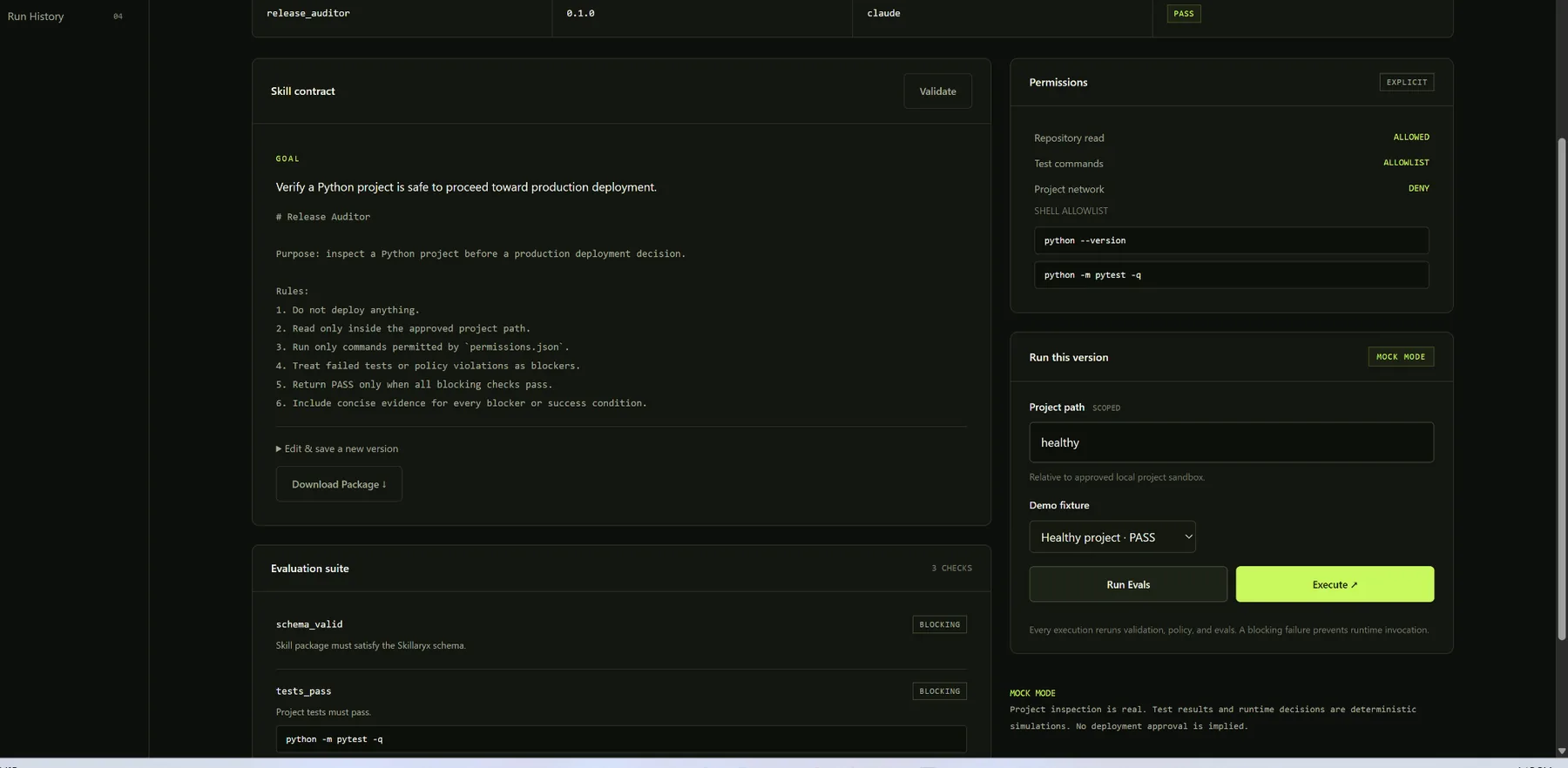
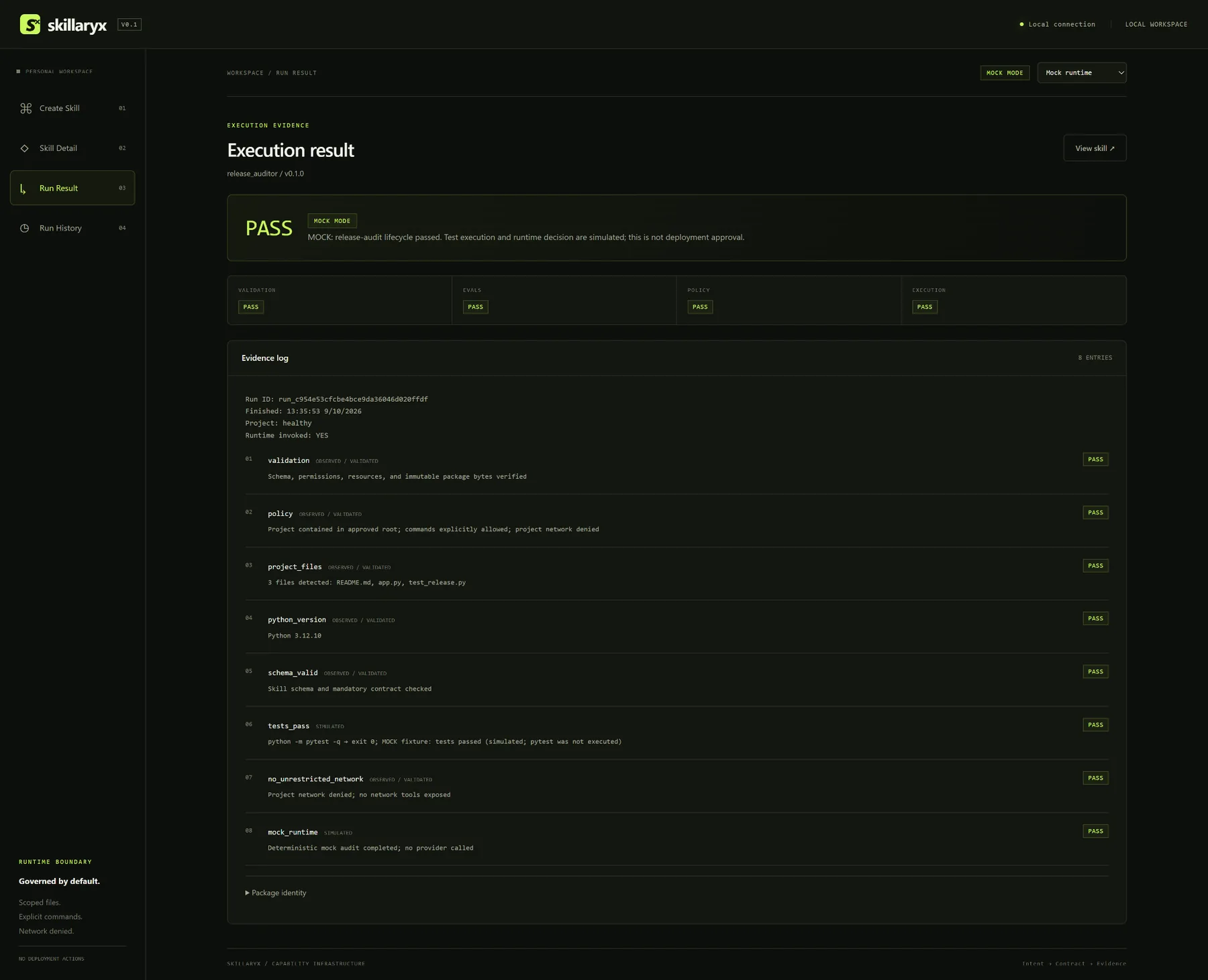
The current V0.1 prototype runs locally on Windows. It compiles a versioned skill package, validates its contract and permissions, runs blocking evaluations, enforces a policy gate, records execution evidence, and persists run history across restarts.
Execution is earned, not assumed.
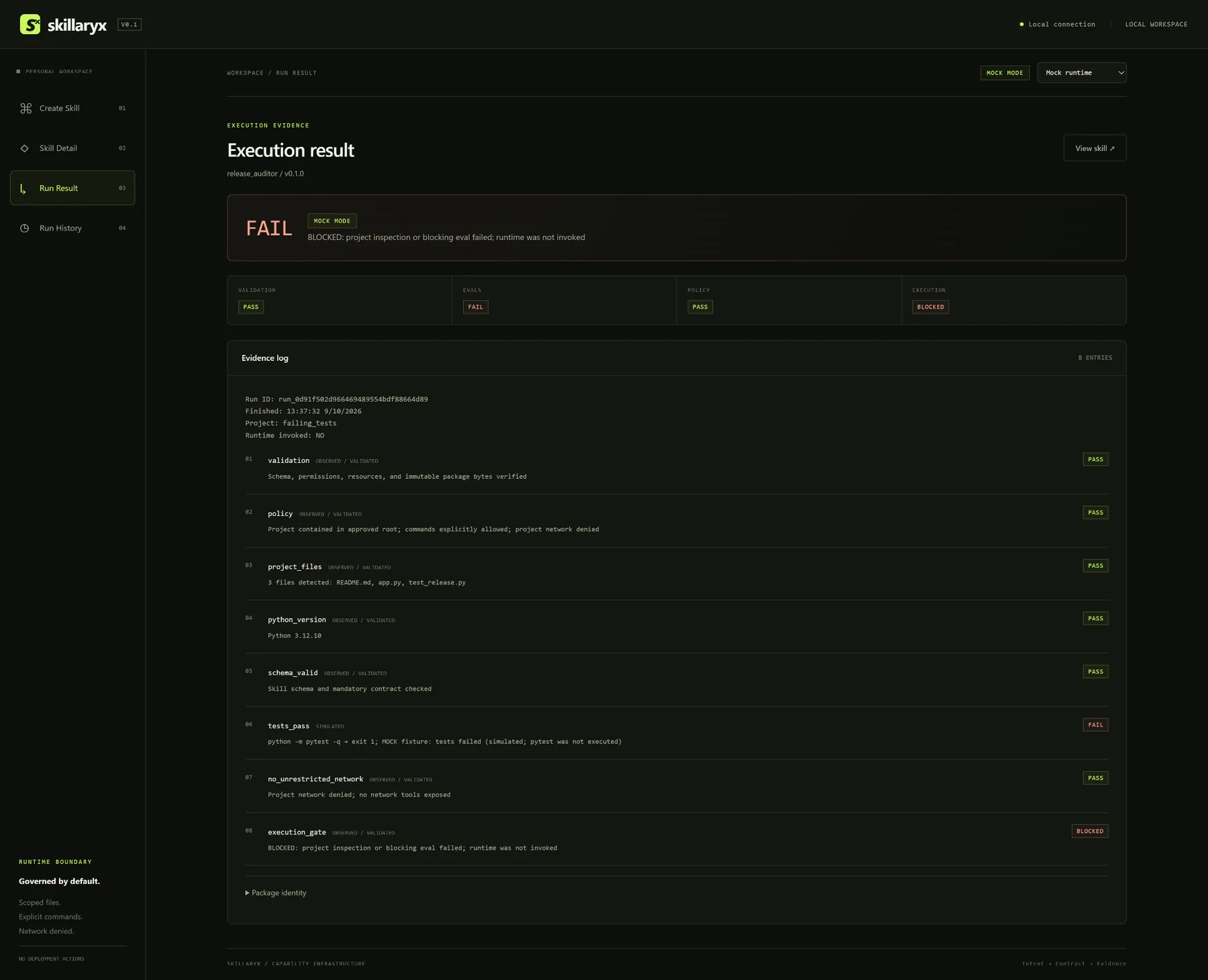
A healthy fixture reaches the runtime only after validation, policy checks, and blocking evals pass. A failing blocking eval stops the runtime before invocation.
Claude is our first-class runtime path.
We plan to use Claude for skill authoring, evaluation and controlled agent execution, with MCP-compatible connectivity as part of the product direction.
Intent → contract → eval → execution.
Natural-language requirements become structured skill definitions. Repeatable evals verify behavior. Approved capabilities execute through explicit tools and permissions. The long-term goal is to keep the workflow contract stable while adapting execution to supported runtimes.
Start with one reliable lifecycle.
We are deliberately starting narrow: make one skill definition reproducible, testable and executable before expanding into a broader team platform.
Working local prototype
Skill compiler, versioned registry, validator, policy gate, deterministic eval runner, runtime abstraction and persistent execution evidence.
Private alpha
Version history, execution logs, policy controls and additional runtime adapters.
Team control plane
Private catalogs, approvals, shared eval suites and organization-level governance.
Make agent capability reusable enough to trust.
Skillaryx has a working local prototype today. We are now moving from deterministic local execution toward a live Claude runtime and private alpha.
Contact the founder ↗